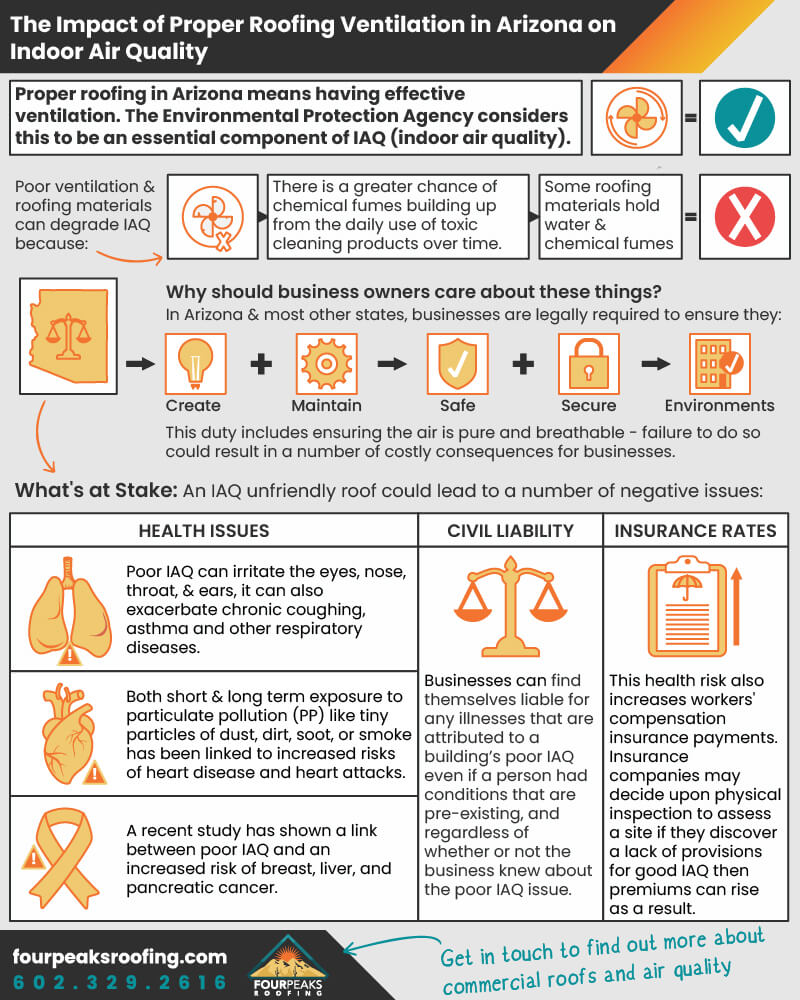
Proper roofing in Arizona supports effective ventilation, which, according to the Environmental Protection Agency, is an essential component of IAQ (indoor air quality).[1] Workers usually use toxic chemicals to clean floors and surfaces in commercial buildings at least once a day. Only effective ventilation prevents toxic fumes from accumulating over time and poisoning IAQ. Furthermore, some roofing materials degrade IAQ because they hold water and chemical fumes—more on these things below.
Since the roof is the last part of a commercial building to be constructed, to many business owners, it’s the last thing they think of. Furthermore, many business owners see roofs as independent objects that provide shelter but have no other function. That’s especially true of unattractive commercial flat roofs. But at Four Peaks Roofing, we prioritize your employees’ and customers’ health and safety, offering appropriate, cost-effective roofing solutions.
What’s at Stake
An IAQ-unfriendly roof is not just unhealthy. It’s unexpectedly costly. It’s a civil liability risk, and it increases insurance rates.
Poor air quality is much more than a comfort issue. Poor air quality is also a severe health issue. Some IAQ-related illnesses include:
- Respiratory Issues Related to Improper Roofing Ventilation in Arizona: Most people know that indoor air pollution can irritate the eyes, nose, throat, and ears. It can also contribute to chronic coughing and classic respiratory problems like excessive phlegm, chest tightness, and shortness of breath. Poor IAQ also exacerbates asthma and other respiratory diseases, such as chronic obstructive pulmonary disease (COPD).
- Heart and Vascular Issues: Short—and long-term exposure to particulate pollution (PP) is linked to an increased risk of heart attacks and other forms of heart disease. Tiny particles of dust, dirt, soot, or smoke are the most harmful PP because people inhale them deeply.
- Cancer: A recent study concluded that poor air quality increases the risk of breast, liver, and pancreatic cancer. According to the study, every ten micrograms per cubic meter (µg/m3) of exposure increases the risk of terminal cancer by 22 percent.[2]
Poor indoor air quality causes other unexpected health problems, such as pneumonia and cataracts.
Why should business owners care about these things?
Their businesses could be held liable for medical expenses and other damages in court.
In Arizona and most other states, businesses usually have a duty to create and maintain safe and secure environments. This duty includes ensuring the air is pure and breathable.
If poor indoor air quality causes one of the illnesses mentioned above, the business could be liable for damages, even if a pre-existing condition contributed to the plaintiff’s illness and the company didn’t know about the IAQ issue.
The same health risk increases workers’ compensation insurance payments. Insurance companies often perform physical property inspections before they assess premiums. During these reviews, inspectors look for IAQ-friendly items like ridge vents, soffit vents, and exhaust fans. If they don’t see them, the cash register rings.
Materials for Proper Roofing Ventilation in Arizona

Proper roof ventilation prevents PP, chemical fumes, and other harmful substances from accumulating and poisoning everyone who walks through the door.
Exterior roof vents are the best way to reduce the percentage of toxic particles in the air below. Standard roof ventilation options include:
- Ridge Vents: Perhaps the most effective roof ventilator runs across the entire span of the roof line. These vents are in prime position to let the hottest air escape the attic space. As a bonus, because they run across the entire roof line, they generally have the surface area necessary for expelling large amounts of hot air.
- Box Vents: Louver Vents are popular and effective. Their small size (usually about 18″ by 18″) is primarily a drawback, but this size increases versatility. Because they don’t need to run across the entire peak of the roof, box vents can be installed strategically in smaller areas that need air vents.
- Powered Attic Vents: A PAV is a window box fan for the roof. The fan removes pollutants and keeps the air at a consistent temperature throughout the year. However, these efficient vents may come at a high cost. In addition to the electricity used to power the fan, recent evidence suggests that powered vents pull up the cool air and cause it to accumulate near the ceiling, forcing the air conditioning unit to work harder.[3]
Attacking Moisture Accumulation
Moisture accumulation, which promotes mold growth, could also be a problem, especially for structures with metal roofs.
A simple polypropylene underlayer often cures this problem. Polypropylene is waterproof because its molecules are so close together that water cannot pass between them. Water droplets form bubbles or beads on the polypropylene and remain static on flat surfaces or roll off if gravity takes hold. Polypropylene is more durable than paper or felt linings, which is popular in residential dwellings.
Four Peaks Roofing is Here to Ensure Proper Roofing Ventilation in Arizona
Contact us to learn more about commercial roofs and air quality.
Source:
[1] https://www.epa.gov/indoor-air-quality-iaq
[3] https://www.fsec.ucf.edu/en/publications/html/fsec-gp-171-00/

