
Good roof ventilation is optional in many parts of the country but vital for healthy roofing in Phoenix, AZ. Depending on the roof type and other factors, improperly ventilated roofs can reach over 200 degrees in the summer.[1] Attic temperatures above 140 or 150 degrees generally overload most HVAC systems. Three or four consecutive 200-degree days are probably enough to make any HVAC system go kaput.
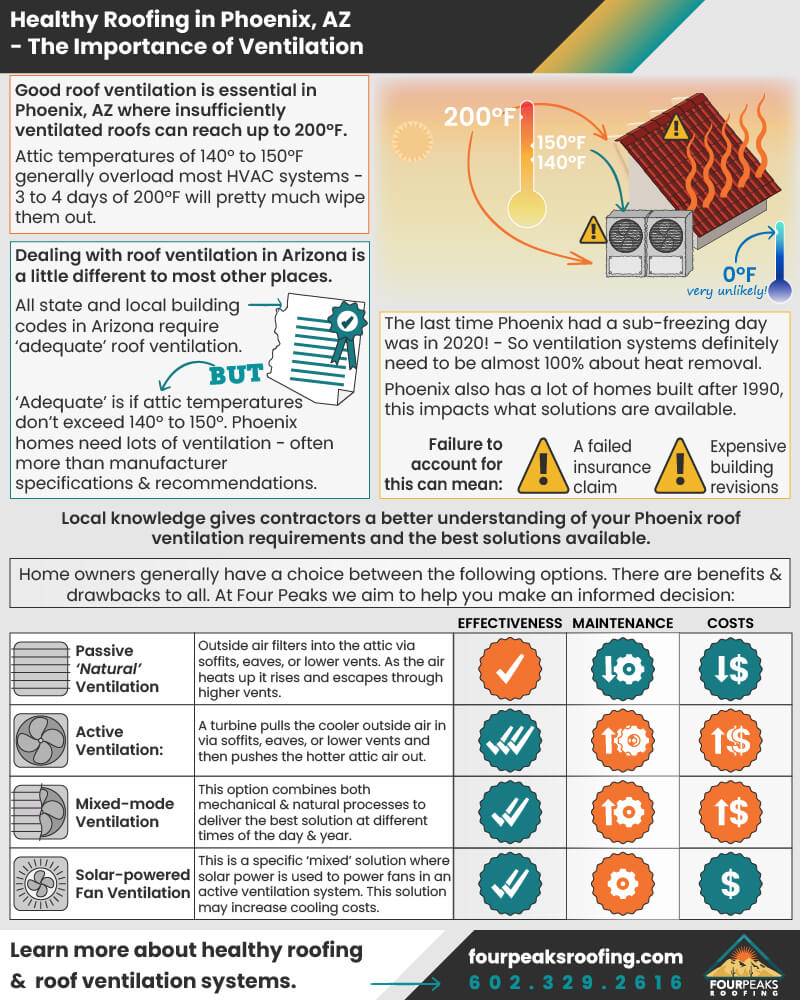
Usually, a roof ventilation system regulates the attic temperature, ensuring it doesn’t get too hot or cold. Arizona is different. Cold attics aren’t a problem here. The last sub-freezing day in Phoenix was in 2020. So, the roof ventilation system must be almost 100 percent geared toward heat removal. Roof ventilation is also different in Phoenix because many homes have been built since 1990. Therefore, only trust a local roofing contractor with these needs, like Four Peaks Roofing.
General Issues
All state and local building codes in Arizona require adequate roof ventilation. Generally, roof ventilation is “adequate” if the attic temperature never exceeds 140 or 150 degrees. Math was never our strong suit, but 140 is much lower than 200. Therefore, your attic requires significant ventilation that, in most cases, exceeds manufacturer specifications and recommendations.
The aforementioned hodgepodge of ventilation temperature requirements is another excellent reason to work with a local Phoenix roofing company. If the ventilation isn’t up to par, a home inspector could require expensive redoes, or an insurance company could deny a claim.
Below, we’ll discuss the specific kinds of available ventilators and other roof replacement materials. In general, homeowners can choose between:
- Passive (Natural) Ventilation: Outside air filters into the attic through soffits, eaves, or lower vents. As that air heats up and rises, it filters out through higher vents. Such a ventilation system can work in an extreme climate like Phoenix but is often inadequate.
- Active Ventilation: A turbine fan pulls the air that filters in through the eaves, lower vents, and soffits and pushes it out of the attic. This system routinely lowers attic temperatures by at least forty degrees, even on hot days. However, the powered fan might offset the HVAC savings.
Mixed-mode ventilation systems are also an option in some cases. They use both mechanical and natural processes. The mechanical and natural components may be used at the same time, at different times of day, or in different seasons of the year.
Since natural ventilation flow depends on environmental conditions, it may not always provide adequate ventilation. Mechanical systems may supplement or regulate the naturally driven flow in this case. However, these systems have lots of moving parts that can break. More on that below.
A solar-powered fan is frequently ideal. It’s inexpensive, like passive ventilation, highly effective, like active ventilation, and easy to maintain, unlike mixed-mode ventilation.
But not so fast. Sometimes, these powered fans draw excessive cool air from below the attic, driving up cooling costs. Since there’s no one-size-fits-all ventilation system, a roofing contractor should prioritize ventilation alongside other matters, such as what type of roofing to install.
Types of Roof Vents for Healthy Roofing in Phoenix, AZ
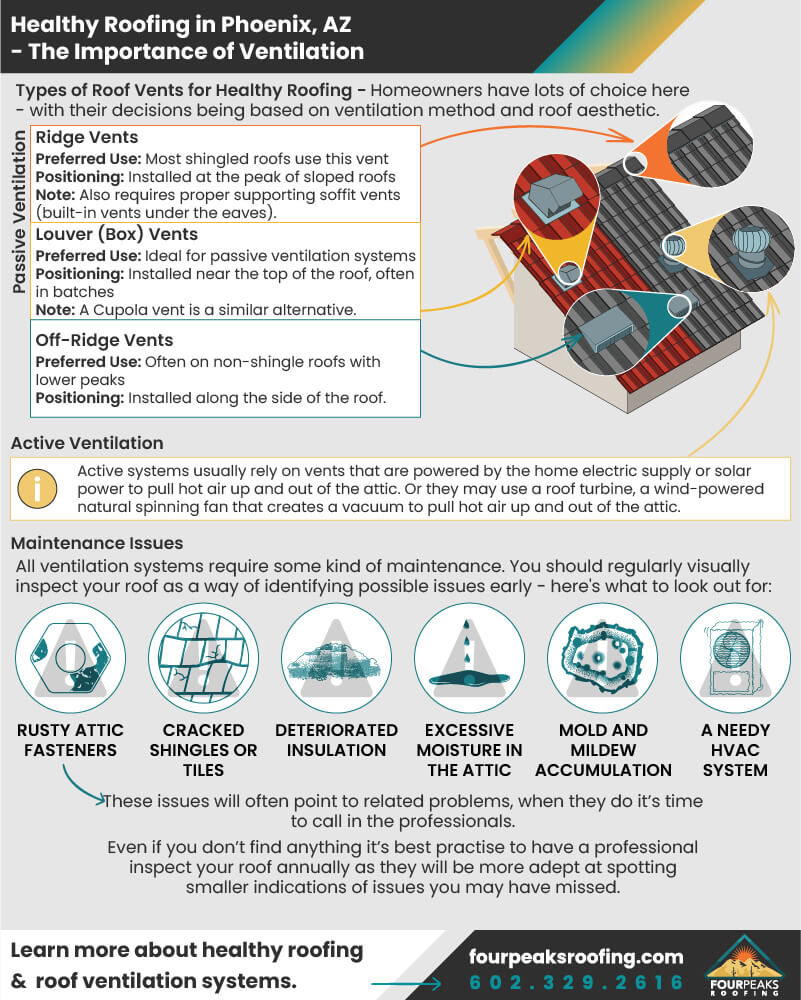
Homeowners have many choices in this area. The right choice must incorporate the ventilation method and roof aesthetic issues. A passive ventilation system usually includes:
- Ridge Vents: Most shingled roofs have ridge vents. These vents, installed at the peak of a sloped roof, allow warm, humid air to escape a building’s attic. They also require proper supporting soffit vents (built-in vents under the eaves).
- Off-Ridge Vents: Non-shingle roofs with lower peaks often have off-ridge vents, which are ridge vents along the sides of the roof.
- Louver (Box) Vents: These simple, cost-effective, durable, and efficient vents, which have a cool name, are ideal for most passive ventilation systems. A Cupola vent is a similar alternative.
An active system usually relies on powered attic vents (ridge or off-ridge vents wired into the home’s electrical grid to pull hot air up and out of the attic), solar-powered fans and vents, or a roof turbine (a wind-powered natural spinning fan that creates a vacuum to pull hot air up and out).
Maintenance Issues
All ventilation systems require some maintenance. A visual inspection is the first step in identifying possible issues. Here are a few things to look for when checking for roof vent problems:
- Rusty attic fasteners,
- Cracked shingles or tiles,
- Deteriorated insulation,
- Excessive moisture in the attic,
- Mold and mildew accumulation and
- A needy HVAC system.
Moisture buildup usually indicates poor air circulation in the attic. A high-maintenance HVAC system might be the symptom of a more serious problem. Professional inspectors should examine roof ventilation systems at least once a year for smaller indications of possible issues.
Contact us to learn about healthy roofing in Phoenix, AZ, and roof ventilation systems.
Source:

