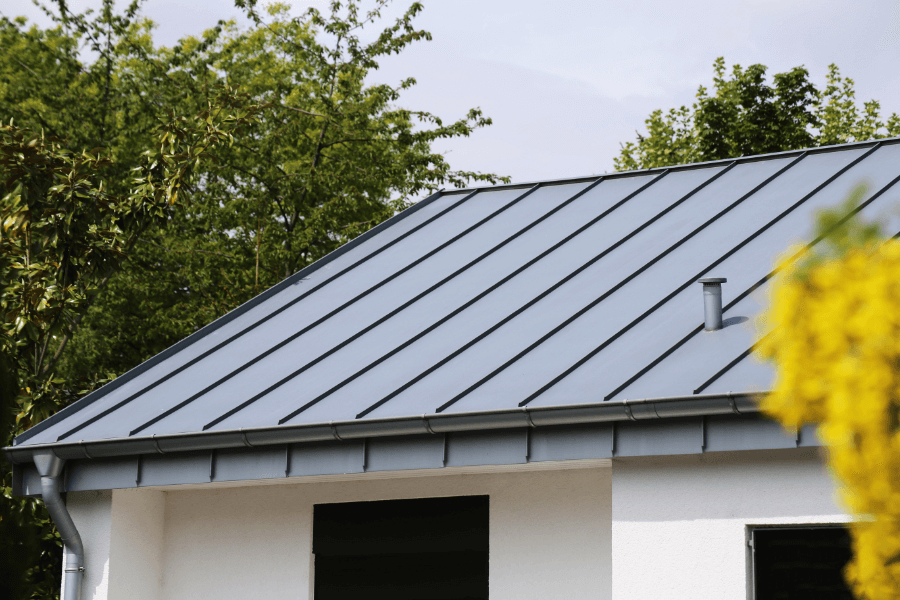
You’d think so. After all, we see consumer affairs news reports about the temperature of metal playground slides, which can reach temperatures of 137 degrees in the summer.[1] But metal roofs are different. In fact, they’re very different. Many types of roofing materials, like asphalt shingles, absorb heat. But metal roofing doesn’t make your house hotter in Phoenix because the metal slats reflect heat. The amount of heat reflection depends on the coating and a few other factors.
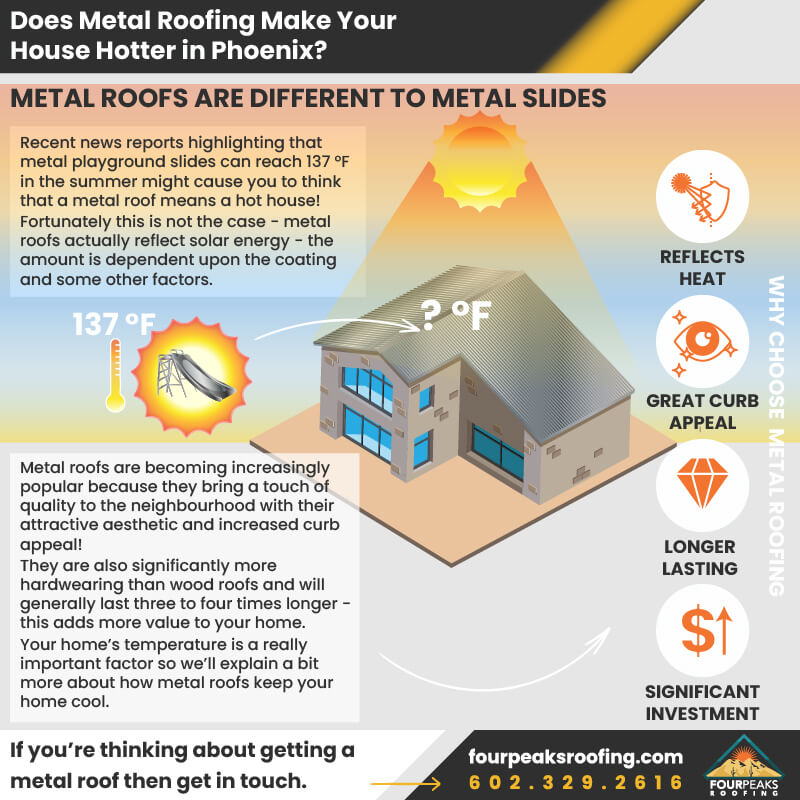
In the 1950s, metal slides were popular among kids and adults because they looked cool and required little maintenance. Today, metal roofs are popular for basically the same reasons. This attractive material sets your house apart from other houses in the neighborhood. Residents feel a little more pride, and your home’s curb appeal increases. Furthermore, whereas wood roofs last about twenty years, metal roofs could last three or four times that long.
If you decide to upgrade to a metal roof, you need a partner like Four Peaks Roofing. Metal roofs are substantial investments since they last so long and look so good. A good roofing contractor should lay out all your options. Furthermore, metal roof projects are substantial undertakings. So, unless the contractor prepares the roof properly, you could be looking at a botched installation.
How Metal Roofing in Phoenix Works
Debate rages on the subject, but there’s no doubt that wearing the proper kind of hat keeps you warmer in winter and cooler in summer.[2] Your roof is your house’s hat. Furthermore, a metal roof is more than metal slats. It’s an entire system designed to control heating and cooling costs.
Low Thermal Mass
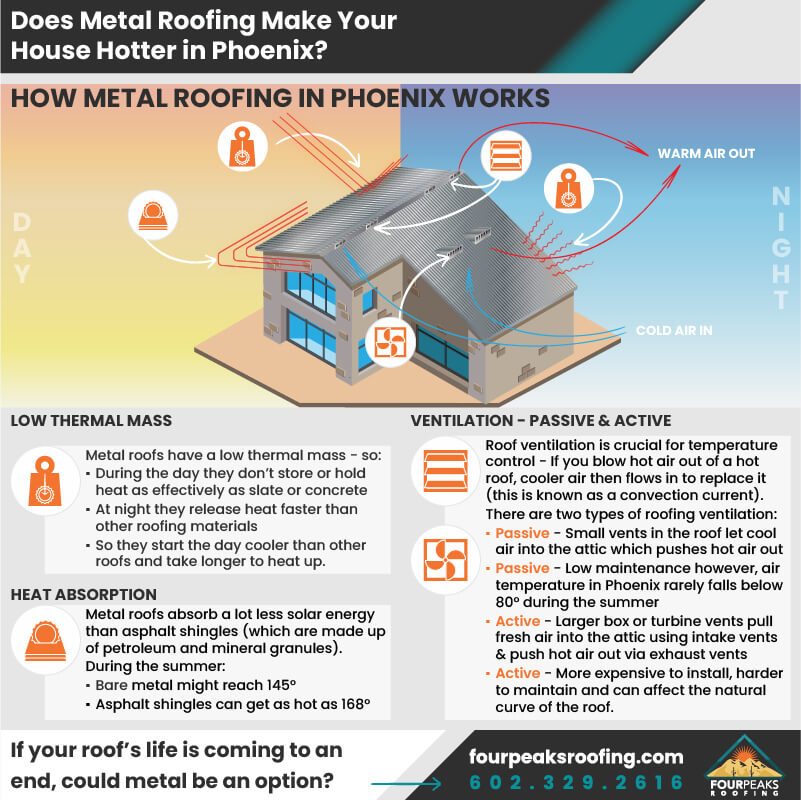
Metal roof materials have a low thermal mass. The mathematical formula (Cth = mcp) is far too complex to understand, but we do understand the effects. A substance with a low thermal mass does not store or hold heat as effectively as slate or concrete, both of which have a higher thermal mass.
Furthermore, metal roofs do not retain heat when the sun goes down. Instead, they release heat much faster than other kinds of roofing materials. So, the next day, it takes longer for the roof to heat up, meaning the other heat-reduction systems don’t have to work as hard.
Heat Absorption
We understand the math a little better on this point. The main ingredients in asphalt shingles are petroleum and mineral granules. These dense, black substances tend to absorb more solar heat. During the summer, bare metal might reach temperatures of around 145 degrees. However, the surface temperature of black asphalt shingles can reach 168 degrees.
You might not feel the heat absorption effect in a one-story house. But it’s noticeable in a multi-story home. The upper floors are closer to the hot roof and further away from the ground-level air conditioning compressor.
Ventilation
If you blow the hot air out of a hot car, the interior cools faster. Likewise, roof ventilation is critical to temperature regulation. Metal roof ventilation is either:
- Passive: Small vents allow cool air into the attic, and this cool air pushes the warm air out. This system works very well in many cases. It’s effective, and the vents are practically maintenance-free. The obvious problem is that the air temperature rarely drops below 80 degrees during a typical Phoenix summer.
- Active: Larger vents, like box or turbine vents, pull fresh air in from the outside and push out the air inside the attic. These vents create a drawing effect when intake vents pull fresh air from outside and then push the air in your attic out of exhaust vents. These vents are more expensive to install, more challenging to maintain, and upset the natural curve of the roof.
We usually recommend active ventilation, although truthfully, either system is effective. A 1,500 SF house would need eight passive vents but only two active vents. Furthermore, several kinds of active vents are available.
Reflectivity and Roofing Systems
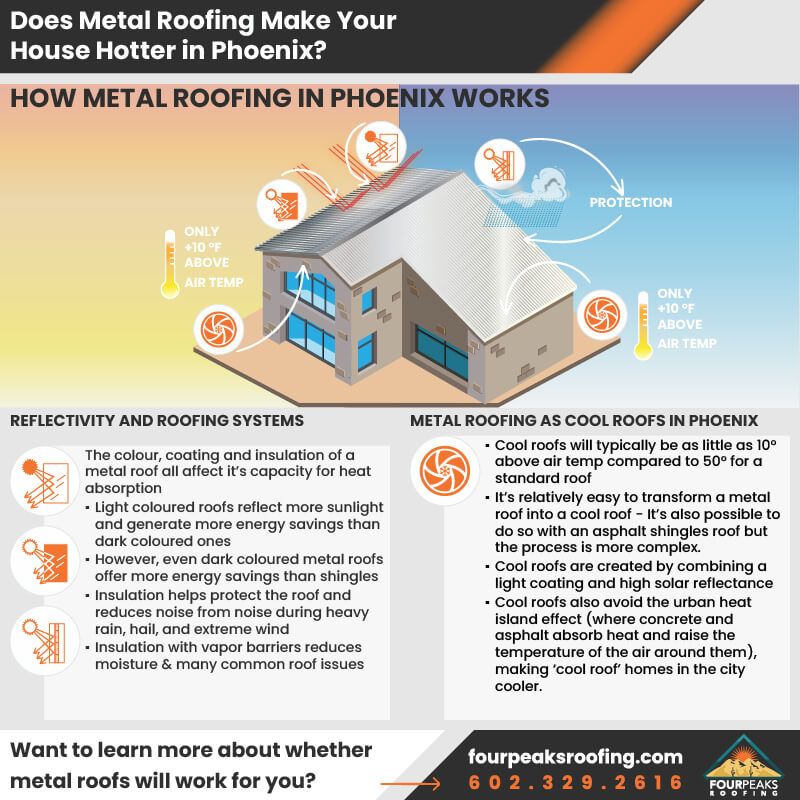
A metal roof’s color and coating significantly affect heat absorption. Light colors reflect more sunlight and lead to more energy savings than dark colors. However, it’s important to mention that even dark metal is a better choice than shingles.
On a related note, insulation also helps protect the roof and the occupied space. Insulation also reduces noise during heavy rain, hail, and extreme wind. Insulation with vapor barriers decreases moisture and several common roofing problems. Once again, many options are available, such as fiberglass batts, rigid foam boards, and spray foam insulation.
Metal Roofing As Cool Roofs in Phoenix
A metal roof is relatively easy to upgrade to a cool roof. Other roofing materials, even asphalt shingles, can also be cool roofs, but the process is complex.
Combining a light coating and high solar reflectance significantly reduces the roof’s temperature. Whereas a standard roof might be 50 degrees warmer than the air temperature, a cool roof could be as little as 10 degrees warmer.
Furthermore, cool roofs mitigate the urban heat island effect. Concrete and asphalt absorb heat and raise the air temperature. So, a cool roof makes a house in the city feel like one in the country.
For more information about metal roofs, contact Four Peaks Roofing today.
Sources:

