

Since 2007, shady home improvement and other such contractors have scammed American families out of more than $200 million.[1] Most people distrust fly-by-night roofing contractors and know that if a deal seems too good to be true, it usually is. But a website and a workshop don’t mean a roofing contractor is willing or able to deliver on the promises it makes.
Many Phoenix roofing contractor companies use the big fish, little fish approach. The big fish get the best crews and top-flight customer service. The little fish get the leftovers. Other contractors never say “no” to a job, even if they know they don’t have the resources or bandwidth to do that job.
A new roof costs lots of time and money. Before spending this time and money, ask a Phoenix roofing contractor about the below areas. If the contractor doesn’t give fast answers that don’t sound rehearsed, keep looking. More than likely, another roof installation company is just a point and a click away.
Phoenix Roofing Contractor Experience
The quality many people exclusively rely on is often somewhat misleading. A losing baseball team that returns all nine starters is experienced, but it’s still a losing baseball team. Nevertheless, if a roofing company has been in business for thirty years, like Four Peaks Roofing, that company is probably reputable.
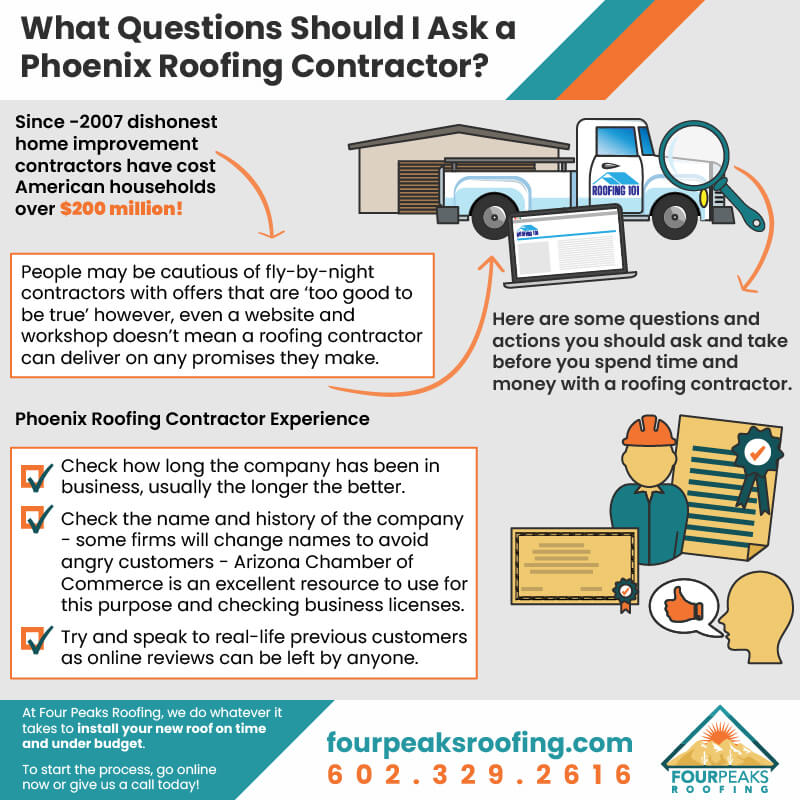
Asking a question may not be enough. Sometimes, customers need to do some research as well. For example, sketchy roofing companies often change their business name to stay one step ahead of angry customers. The Arizona Chamber of Commerce has an excellent business name database.[2] A search may cost a few dollars, but considering how much a new roof costs, that’s a minimal investment that brings considerable peace of mind. On a related note, the Chamber of Commerce also maintains a business license database.
Reputable roofers also have real-life satisfied customers. Don’t rely on Google reviews. Generally, anyone can write anything online.
Insurance
All roofers need general liability insurance. Such policies cover immediate and future damage. More than likely, especially if the roofing contractor checks the other boxes on this list, the crew won’t break anything and won’t improperly install the roof. But we have insurance, so we’re covered if the unexpected happens.
The company should also have workers’ compensation insurance. These policies compensate workers for falls and other job-related injuries. Such accidents are relatively common at roof construction sites. The homeowner could be legally responsible for such damages if the company doesn’t have workers’ comp.
Once again, these inquiries often involve some follow-up. If the company doesn’t immediately provide proof of insurance or seems uncomfortable talking about this subject, the homeowner should probably verify the policy.

Subcontractors
These inquiries sometimes go together. Inexperienced companies often rely on subcontractors. Overworked companies often rely on subcontractors as well.
Frequently, “subcontractor” is a euphemism for “day laborer.” That’s not necessarily a bad thing. Day laborers are usually very hard workers and highly skilled workers as well. These workers are generally better than many contractors’ aforementioned second-string workers.
However, companies using subcontractors raises legal and quality issues. Liability and workers’ compensation insurance policies often don’t cover non-employees, such as independent contractors or subcontractors. As a result, as discussed above, homeowners could be legally responsible for accidental damage or injury.
The language barrier comes into play as well. Good roofers are good roofers, regardless of what language they speak. But the language barrier often affects job and safety instructions. Even if someone interprets the instructions, many details may get lost in translation.
Additionally, general contractors often don’t vet subcontractors very well. Instead, they confuse the willingness to work with the ability to work. That’s especially true if the project is a terra cotta or other non-asphalt tile roof.
The Old Roof
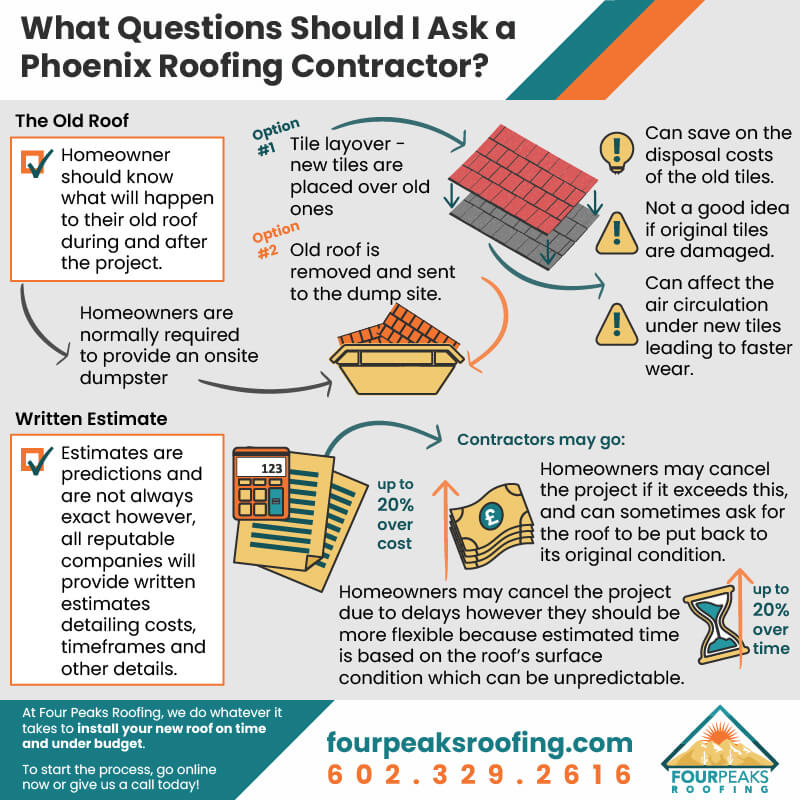
This question is two questions in one. Homeowners should know what’ll happen to the old roof during and after the project.
Frequently, roofing contractors lay new shingles directly over the old ones. That’s usually not a bad idea, primarily because of the disposal issues discussed below. However, a tile layover is a bad idea if the old roof is damaged, which is probably why the homeowner called a roofing contractor in the first place. Additionally, tile layover often affects air circulation under the new tiles, causing them to wear out faster.
Speaking of disposal, in most cases, the homeowner must provide an onsite dumpster. Then, the homeowner must hire someone to haul this refuse to the dump. At Four Peaks Roofing, we always give homeowners volume estimates, so they can secure the proper size dumpster and make disposal arrangements.
Some contractors think they’re doing homeowners a favor by covering the old tiles and eliminating this burden and expense. Sadly, good intentions often produce bad results. We probably all have experience in this area.
Written Estimate
An estimate is a prediction, and predictions aren’t always correct. Nevertheless, especially if the company is experienced, you should receive a written estimate that includes the cost, timeframe, and other details. Companies that don’t commit to written estimates usually won’t commit to anything.
Generally, roofing companies can go about 20 percent over the estimated cost without the homeowner’s authorization.[3] If fees run higher, the homeowner can pull the plug, and, in some cases, the contractor must undo any work done to put the roof back into its original condition.
The same basic rule applies to the timeline. The homeowner should give the roofer a little more leeway in this area. The roofer makes a time estimate based on the roof’s surface condition. Subsurface conditions are very unpredictable.
On a related note, rain delays aren’t a problem in Arizona as long as work isn’t scheduled during July, which passes for the rainy season in Phoenix. Nevertheless, the contractor should have a bad-weather plan that includes protective tarps.
Contact Our Phoenix Roofing Contractor Professionals
At Four Peaks Roofing, we do whatever it takes to install your new roof on time and under budget. To start the process, go online now or give us a call today!
Sources:
[1] https://www.inspectionsupport.com/resources/home-improvement-scams-trends-report-2022/
[2] https://www.azcommerce.com/small-business/checklist-items/business-considerations/researching-business-name-availability/
[3] https://www.disputeresolutionombudsman.org/blogs/q-what-is-the-difference-between-and-estimate-and-a-quotation-and-why-is-it-important

